
Portfolio Content System.

Many properties. One place to keep the work moving.

Product designWeb applicationAnalytics
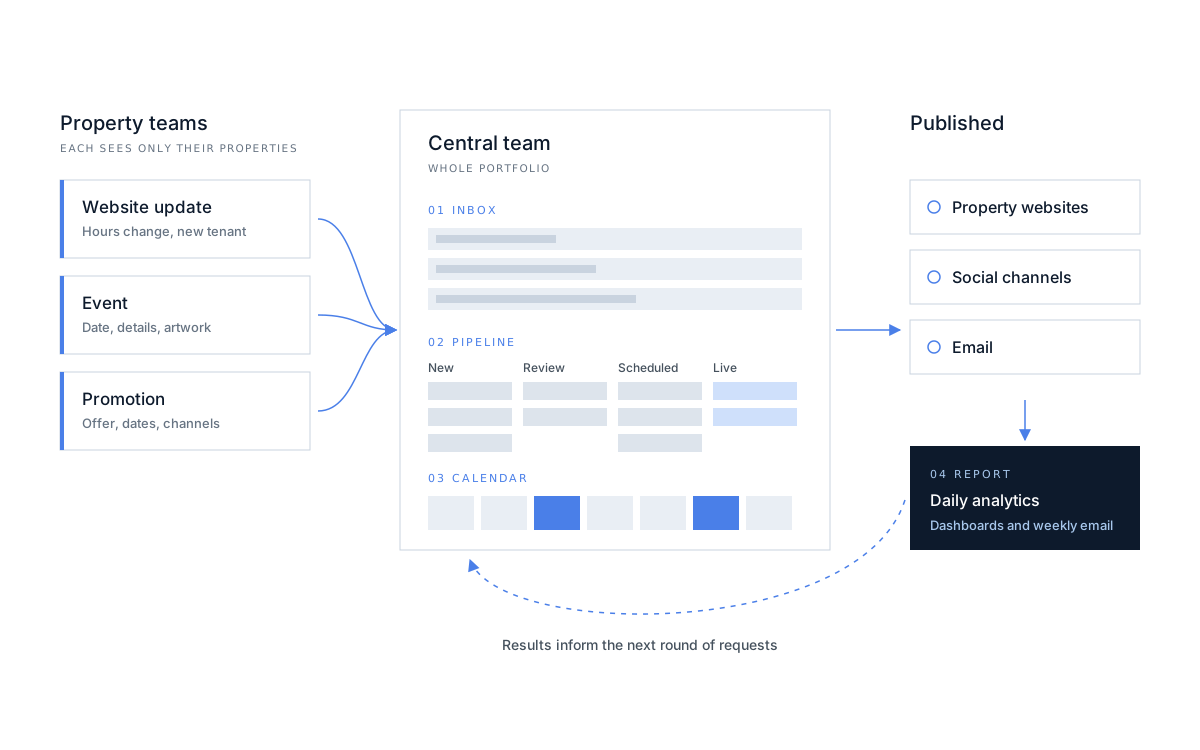
Diagram: property requests move through a central inbox, a pipeline and calendar, publishing, and daily reporting.

The work was shared. The information wasn’t.

Website updates, events, and promotions arrived through emails and individual messages. Schedules were hard to see across the portfolio. Performance numbers lived in separate analytics accounts.

The application gives property teams a place to ask and central teams a place to plan, follow through, and review results.
From a request to a plan.

Every request follows the same four steps, with its files and comments attached.

  1. Request

    A property submits the work it needs.

  2. Review

    The central team works through the inbox and pipeline.

  3. Schedule

    Approved work gets a date on the shared calendar.

  4. Report

    Teams review performance by property and across the portfolio.

See what’s next. Across the portfolio.

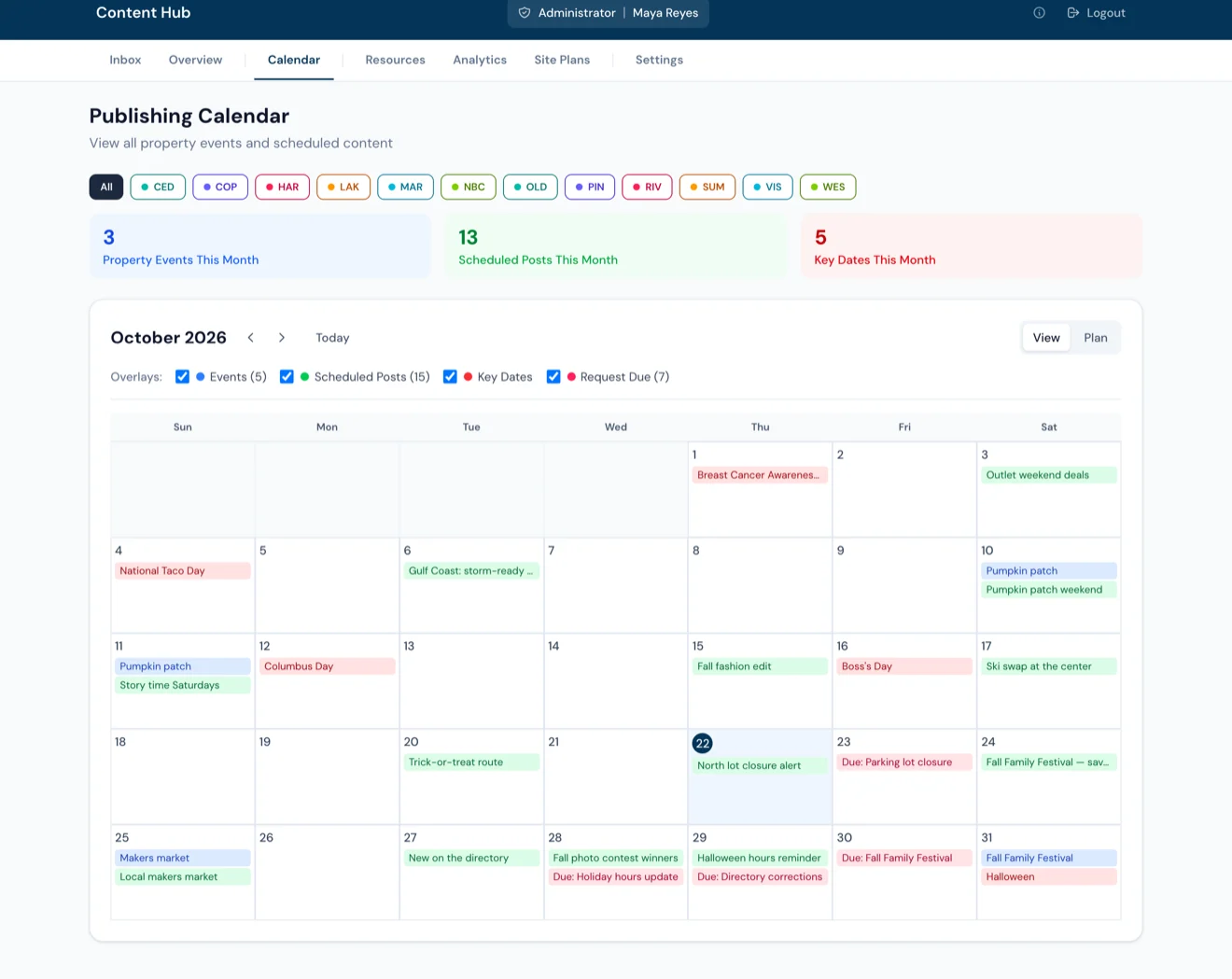
Property events, scheduled posts, and key dates sit together. Filters bring individual properties into focus.

The publishing calendar for October: property events, scheduled posts, key dates, and request due dates across a dozen properties.
A portfolio view of the publishing calendar.

One system. Different responsibilities.

At the property

A clear place to ask.

Property managers access their own properties, submit requests, and follow the work.

Across the portfolio

The whole picture.

The central team moves between inbox, pipeline, and calendar views, with portfolio and property dashboards close by.

A report you open. Not one you rebuild.

Scheduled jobs bring analytics into the application each day, and property and portfolio dashboards keep those numbers alongside the work. Google Analytics and Meta are connected today; other sources can be added the same way.

Website analytics run daily for every property. Social metrics were piloted on one.
  1. Google Analytics, Meta, and other sources
  2. Collected daily
  3. Property and portfolio dashboards

Project notes

Our role
Design and development end to end: interface, database, access rules, integrations, and deployment.
Built with
Next.js and PostgreSQL, email sign-in with one-time codes, property-based access, creative asset storage, and scheduled Google Analytics and Meta integrations.
Context
In production across a portfolio of more than a dozen properties.
What changed
Requests, approvals, schedules, and performance numbers live in one system shared by property and central teams, instead of scattered inboxes and separate analytics logins.